Know the design behind your vision.
The Optic Forge uses IOT lens-design technology because customers deserve more than an unexplained label like “standard” or “premium.” This guide shows how a digital lens is calculated, why different designs serve different lives, and what the lab verifies before production.
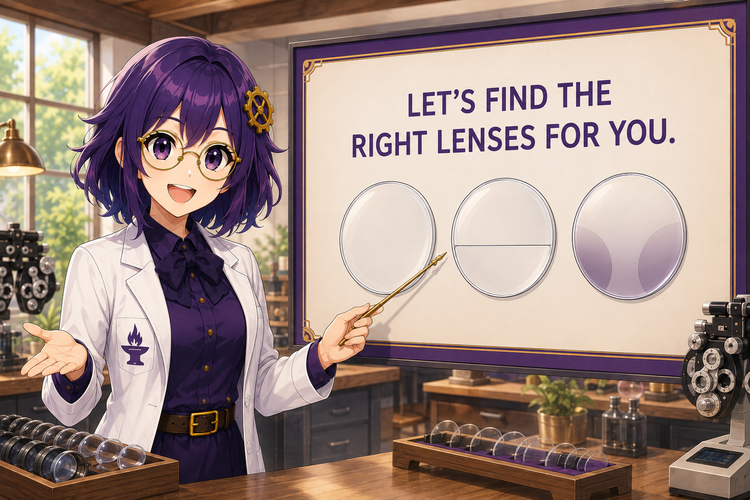
IOT helps us build around the wearer—not just fill a prescription.
A prescription tells us the powers a customer needs. A lens design determines how those powers are arranged and optimized across the finished lens. IOT gives our lab a portfolio of free-form designs for everyday vision, driving, outdoor activity, office work, and higher levels of personalization.
Free-form calculation
The optical surface is calculated digitally, point by point, so the finished design can do more than a basic stock lens or conventional surface.
Digital Ray-Path 2
IOT’s calculation technology considers how the wearer looks through the lens across different gaze directions and working distances. Personalization depends on the data available for the order.
Steady Methodology
IOT describes Steady as controlling unwanted lateral power variation to support image stability and reduce the “swim” some progressive wearers notice.
Camber Technology
Camber pairs a variable-base-curve front surface with a digitally designed back surface. In our proposed lineup, it anchors the highest-refinement progressive tier.
One IOT portfolio, several visual purposes.
The final public product names will be approved with IOT. The customer experience will continue using simple Forge categories first, followed by the technology behind them.
Forge Single Vision
IOT platform: Endless Single Vision. One viewing purpose—distance, reading, or computer—with a digitally calculated free-form surface.
Forge Office Lens
IOT platform: Endless Office Occupational. Built to emphasize near and intermediate tasks around a desk, screen, counter, or room—not driving.
Forge Lined Bifocal
A visible, stable distance-and-reading solution. We will confirm the exact IOT design name, configuration, supported segments, and approved customer description.
We recommend by lifestyle—not by pushing everyone upward.
Customers will see a clear Forge category first and the IOT design behind it second. The lab can then explain why the design matches everyday needs, what technology supports it, and what tradeoffs remain. Exact product mapping and claim language are presented here for IOT review.
How every progressive shares the lens
The prescription changes gradually from the top of the lens to the bottom. The design decides how much room and priority each viewing area receives—and how the unavoidable peripheral blur is managed.
- No visible bifocal line
- Smooth power change rather than a hard jump
- Distance, intermediate, and near priorities can differ by design
- Some peripheral blur remains normal in every progressive
- Accurate fitting measurements and frame position matter
Forge Standard Progressive
IOT platform: Essential Steady Progressive. Our accessible balanced design for customers who want an everyday progressive without paying for personalization they may not need.
Forge Driving Progressive
IOT platform: Endless Drive Progressive. A specialized design that gives greater attention to the road, mirrors, dashboard, navigation, and the repeated distance-to-intermediate shifts involved in driving.
Forge Sport Progressive
IOT platform: Endless Sport Progressive. Intended for outdoor activity, sunwear, active movement, and customers who place a high priority on distance vision—including more wrapped frame shapes when appropriate.
Forge Top-tier Progressive
IOT platform: Camber Steady Plus Progressive. Our highest-refinement option, combining the Camber variable-base-curve blank with IOT’s back-surface calculation and Steady Plus approach.
Trust is not just the design name. It is the work behind it.
The page will show customers that a premium design cannot rescue incomplete information. The Optic Forge gathers the required order details, the IOT calculation supports the selected design, our production partner manufactures the lenses, and the completed pair returns to West Virginia for inspection.
Required optical measurements
Monocular or binocular PD as appropriate, fitting/segment height for multifocal designs, prescription values, and the selected frame’s dimensions must be accurate.
Personalization when supported
Vertex distance, pantoscopic tilt, wrap angle, corridor/design configuration, and other frame-and-wearer parameters may improve the calculation when the selected design and fulfillment process support them.
Honesty when defaults are used
If a parameter is unavailable and the design uses a standard value, the guide should say so. “Personalized” must describe the data actually used—not become an automatic marketing label.
Material affects thickness, impact resistance, weight, and clarity.
The most expensive material is not automatically the best. A lower prescription may look and perform beautifully in CR-39, while a stronger prescription may benefit from 1.67. Children and active wearers often benefit most from Polycarbonate.
CR-39 (Plastic)
CR-39 is a traditional optical plastic known for good visual clarity and affordability. For many mild to moderate prescriptions, it produces a comfortable everyday lens without paying for a higher index.
Polycarbonate
Polycarbonate is lightweight and much more impact resistant than ordinary optical plastic. It is frequently selected for children, active lifestyles, and situations where durability matters.
1.67 High Index
1.67 bends light more efficiently, allowing a stronger prescription to be made thinner and flatter than CR-39 or Polycarbonate. Frame size and shape still have a major effect on final thickness.
What every treatment does—and what it does not do.
Sun and color choices are separate paths in our builder so incompatible selections cannot be stacked together. Coatings and coverage are added separately unless the option specifically says they are included.
Photochromic · +$89
Photochromic molecules react to outdoor light—especially ultraviolet light—by darkening, then gradually return toward clear when the UV exposure is removed. We offer Gray or Brown.
Polarized · +$119
Polarization filters intense reflected glare from horizontal surfaces such as wet roads, water, snow, and vehicle hoods. It can make bright outdoor environments more comfortable and is often a strong choice for daytime driving.
Solid Tint · +$39
A solid tint keeps a similar color density across the entire lens. It is useful for consistent sunglass color, fashion, or light sensitivity preferences when a fixed tint is appropriate.
Gradient Tint · +$49
A gradient is darker at the top and fades lighter toward the bottom. It can reduce overhead brightness while leaving the lower lens lighter for reading a dashboard, phone, or menu.
Mirror Finish · +$89
A mirror finish adds a reflective front appearance over a Gray or Brown base. Customers select both the base color and mirror color. It is a sun/color path and cannot be combined with Photochromic or another tint path.
Premium Anti-Reflective · +$79
Premium AR reduces reflections from the lens surfaces, allowing more light to pass through the lens. It can improve cosmetic appearance, make the eyes easier to see in photographs and conversation, and help reduce distracting lens reflections at night.
Backside AR · +$39
Light can enter from behind you and reflect off the inside surface of a sun lens back toward your eye. Backside AR reduces those rear-surface reflections, which can be especially useful on sunglasses and strongly reflective front treatments.
Blue-Filter Material · +$15
This material filters a portion of visible blue light and may slightly change how reflections or color appear. Some customers prefer it for personal comfort or appearance.
Scratch-Resistant Coating · Included
Our base lens pricing includes a premium scratch-resistant coating to improve everyday durability. It is especially useful because optical plastic can otherwise mark during normal handling.
One-Year Lens Warranty · +$30
The optional warranty covers qualifying normal everyday lens wear for 12 months, including eligible scratches or coating issues, plus one eligible doctor-documented prescription change during the coverage period.
30-Day Return Period · Included
Contact us within 30 calendar days after delivery to request a return. Normal try-on and progressive-adaptation wear are allowed, but the complete pair must be returned with all included items and without customer-caused damage.
The customer learns what the design does before seeing what it costs.
Lens prices are per pair and the frame is added separately. The Forge name stays simple in the builder; this guide shows the proposed IOT design beneath it so customers can understand what they are receiving. Final mappings remain subject to IOT and production-partner confirmation.
| Lens design | CR-39 | Polycarbonate | 1.67 High Index | Best starting point |
|---|---|---|---|---|
| Single VisionProposed: Endless Single Vision | $89 | $99 | $159 | One viewing distance |
| Lined BifocalIOT design name to be confirmed | $109 | $139 | $219 | Stable distance and reading zones |
| Standard ProgressiveProposed: Essential Steady Progressive | $189 | $219 | $269 | Balanced everyday progressive |
| Driving ProgressiveProposed: Endless Drive Progressive | $209 | $229 | $289 | Frequent driving and travel |
| Sport ProgressiveProposed: Endless Sport Progressive | $209 | $229 | $289 | Outdoor and active environments |
| Top-tier ProgressiveProposed: Camber Steady Plus Progressive | $329 | $359 | $439 | Highest design refinement |
| Office LensProposed: Endless Office Occupational | $89 | $99 | $129 | Desk and room distances |
Mockup note: prices are carried forward from the current Forge guide. Product names, availability, technology mapping, supported parameters, materials, and claims must be confirmed before the preview banner is removed.
What we want to confirm before this becomes public.
This mockup is intended to show the purpose and tone of the page: educate first, make the IOT technology visible, set honest expectations, and help customers trust the design they are receiving. This review panel will be removed from the public version.
Mockup research basis: IOT’s official pages for the IOT portfolio, Endless Steady, Endless Drive, Endless Sport, and Camber Steady Plus.
Still deciding?
The builder lets you choose the closest match. The lab reviews the prescription, frame, material, and options before production begins.
What is IOT?
IOT is the lens-design technology company behind the free-form designs proposed for The Optic Forge lineup. On this page, “IOT” refers to optical lens design—not the “Internet of Things.” The exact public brand description will be approved with IOT before launch.
Does IOT manufacture my glasses?
IOT provides lens-design technology. Our approved U.S. production partner manufactures the order, and the finished pair returns to The Optic Forge in West Virginia for inspection and shipment. We will confirm the exact partner-language requirements before publication.
Why show the design company at all?
Because “premium” should not be a mystery. Showing the design platform lets customers understand why a lens exists, what data supports it, what it may help with, and what limitations still apply. Transparency is part of the product.
Is the most expensive lens always the best?
No. The best lens is the one that fits the prescription, measurements, frame, and daily use. A mild prescription may be excellent in CR-39, while a stronger prescription may justify 1.67. A Standard Progressive may be the right value even when a Top-tier option exists.
Will a progressive have perfectly clear vision everywhere?
No progressive can make every point of the lens equally clear because multiple powers must share one lens. The goal is to arrange the useful zones well and manage peripheral blur. Design quality, measurements, frame fit, and adaptation all matter.
How should a first-time progressive wearer begin?
Start with the new pair first thing in the morning and wear it consistently instead of switching repeatedly to the old pair. Point your nose toward the task, use care on stairs, and wait to drive until vision feels clear and comfortable. Consult your eye doctor if symptoms persist or if you have any sudden or concerning vision change.
Do photochromic lenses become sunglasses inside a car?
Usually not to the same degree as outdoors. Most car windshields block much of the UV that activates ordinary photochromic lenses. A dedicated polarized sunglass is usually the stronger driving-glare choice.
Should every child have Polycarbonate?
Polycarbonate is generally our preferred starting point for children because impact resistance is usually more important than making a mild prescription thinner. The final choice still depends on the prescription, frame, and intended activity.
Does AR stop all nighttime glare?
No. AR reduces reflections created by the lens surfaces, but it cannot remove glare caused by weather, windshields, eye conditions, large pupils, or uncorrected prescription changes. Night-driving difficulty should be discussed with an eye-care professional.
Can I add Backside AR to Mirror?
You do not need to. Mirror already includes Backside AR in our pricing, and the builder prevents a duplicate charge.
Can I combine Photochromic, tint, Polarized, and Mirror?
No. These are presented as separate sun/color paths. The builder prevents incompatible combinations and then allows eligible coatings or warranty coverage to be added separately.
What is the difference between the return period and lens warranty?
The included 30-day return period applies to a complete pair when the return is requested within 30 calendar days after delivery. The optional one-year lens warranty applies to eligible normal-wear issues and one eligible doctor-documented prescription change during its coverage period. Both require the glasses to be returned for inspection, and neither covers loss, intentional damage, misuse, or unauthorized alteration.
What if I choose the wrong option?
Send the closest build you can. The Optic Forge reviews the prescription and product choices before payment and production. If something is incompatible, unclear, or poor value, we pause and contact you.
Choose with confidence—not guesswork.
Browse the frame collection, then use what you learned here to choose the closest lens starting point. The Optic Forge reviews the prescription, measurements, frame, and design before production.